
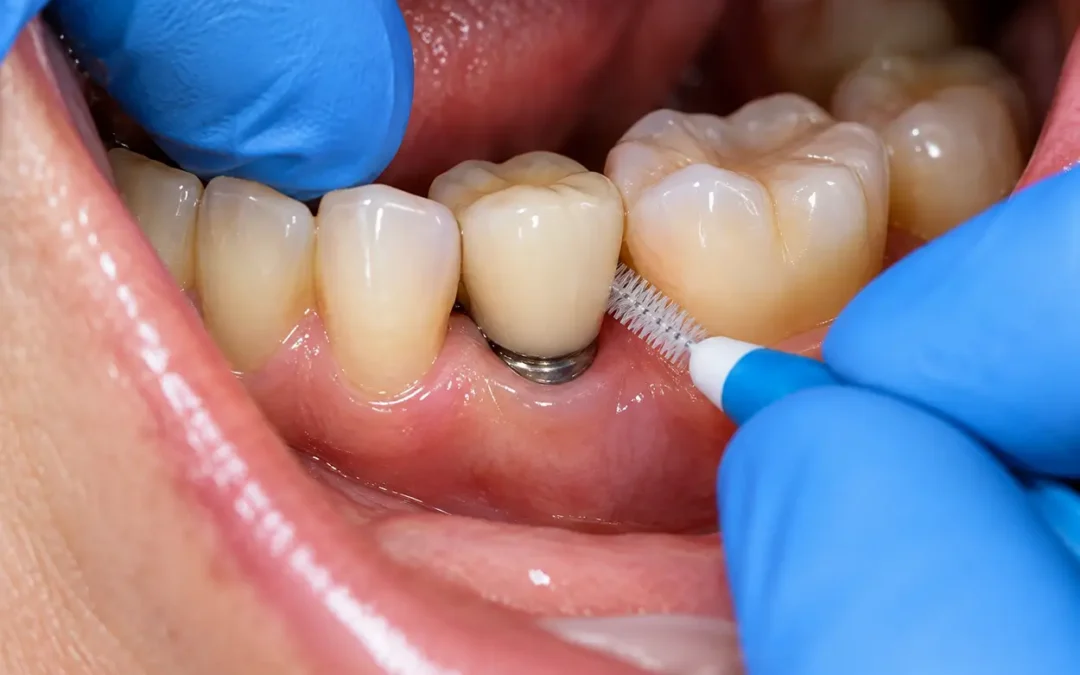
You finish a meal, run your tongue along your teeth, and there it is again: food wedged beside the same implant crown. When food gets stuck around a dental implant once in a while, it may be nothing unusual. When it keeps happening in the same place, though, the space between the implant crown and the neighboring tooth, the shape of the restoration, or the gum contour may have changed.
The implant itself can still be stable. A recurring food trap is often a problem with the area around the restoration rather than proof that the implant has failed.
Why a Food Trap Usually Has a Reason
A dental implant is anchored to bone and does not shift in the same way a natural tooth can. Teeth beside an implant are supported by periodontal ligaments and may drift slightly over time. Even a small change in that relationship can create enough space for fibrous foods to be pushed between the teeth during chewing. Food may also collect because of the shape of the implant crown, changes in the gum tissue, or a problem with the neighboring tooth.
The Contact Point May Have Opened
Neighboring teeth normally touch at a small area called the contact point. That contact helps guide food over the teeth instead of into the gum. If a natural tooth beside an implant shifts while the implant remains fixed, the contact can open. Floss may begin to slide through more easily than it used to, and food may pack into the same space after almost every meal.
An open contact is a mechanical change, not something you caused by choosing the wrong food. Keeping the area clean may reduce irritation, but brushing harder will not close the gap. Correcting it may involve the implant crown, the adjacent tooth, or both, depending on what the dentist finds.
Crown Shape and Gum Contours Matter
An implant crown has to look natural, meet the neighboring teeth properly, and still leave an area that can be cleaned. If the crown contour is too flat, too bulky, or poorly positioned, food can collect along the side or near the gumline. Gum recession or loss of the small triangle of tissue between teeth can create additional space even when the crown itself has not changed. A dentist can determine whether the recurring food trap is coming from the contact, the crown shape, the gum tissue, or a combination of those factors.
Could Gum Changes Make the Problem Worse?
Inflamed or receding gums can make a food trap feel more noticeable and harder to clean. Repeated packing may also keep the area irritated. Bleeding does not automatically mean the implant is failing, but frequent bleeding, swelling, tenderness, drainage, or a persistent bad taste deserves an examination because healthy implants still depend on healthy surrounding tissues.
What You Can Do at Home
When food is trapped, rinse gently with water and clean the area without forcing anything under the gum. Floss may work well if it passes comfortably. Some implant spaces are easier to clean with an interdental brush or water flosser, but the right tool depends on the shape of the restoration and the size of the space. Your dentist or hygienist can show you which option is appropriate.
Avoid using a pin, fingernail, or other sharp object to dig food out. If floss repeatedly shreds, catches under an edge, or passes through without the resistance you feel elsewhere, make a note of it. Those details can help the dentist identify the source of the problem.
When to Have the Area Checked
Occasional food between teeth happens. A food trap around a dental implant should be checked when it keeps returning in the same place, becomes harder to clean, or is getting worse. Arrange an evaluation sooner if the gum repeatedly bleeds, looks swollen, feels sore, develops an unpleasant taste or odor, or seems to be pulling away from the crown. If the restoration moves, clicks, feels different when you bite, or becomes painful, avoid chewing on that side until it has been examined.
How a Dentist May Correct the Problem
The dentist may check the contact with floss, examine the crown and gum tissue, evaluate the bite, and use an X-ray if the bone level or fit of the restoration needs clarification. The goal is to find out why the space exists before deciding how to correct it.
If the contact is open, treatment may involve modifying or repairing the restoration, replacing the crown when its shape or fit cannot be corrected predictably, or treating the neighboring tooth if it is part of the problem. When gum inflammation or tissue changes are contributing, professional cleaning, a different home-care method, or periodontal treatment may also be recommended.
Is Food Trapping a Sign the Implant Is Failing?
Usually, food trapping by itself does not prove that the implant fixture has failed. The implant can remain firmly integrated with bone while the crown contact or gum contour creates an irritating space. Still, food and plaque left in the area can inflame the tissue, and the natural tooth next to the implant can still develop decay. That is why a recurring food trap is worth addressing even when the implant feels completely solid.
Protect the Area Before It Becomes Sore
You should not have to plan every meal around what might lodge beside an implant. Gently clean the area, pay attention to when the problem happens, and have the same recurring food trap evaluated. Identifying the cause is the most reliable way to protect the gum, the neighboring tooth, and the comfort of the restoration.
Get Help With a Persistent Implant Food Trap
If food repeatedly catches around an implant crown, Houston Dental Implants can examine the contact, the restoration, and the surrounding gum tissue to find the cause. Learn more about dental implant services, or contact the office to schedule an evaluation and get guidance on cleaning the area safely.